
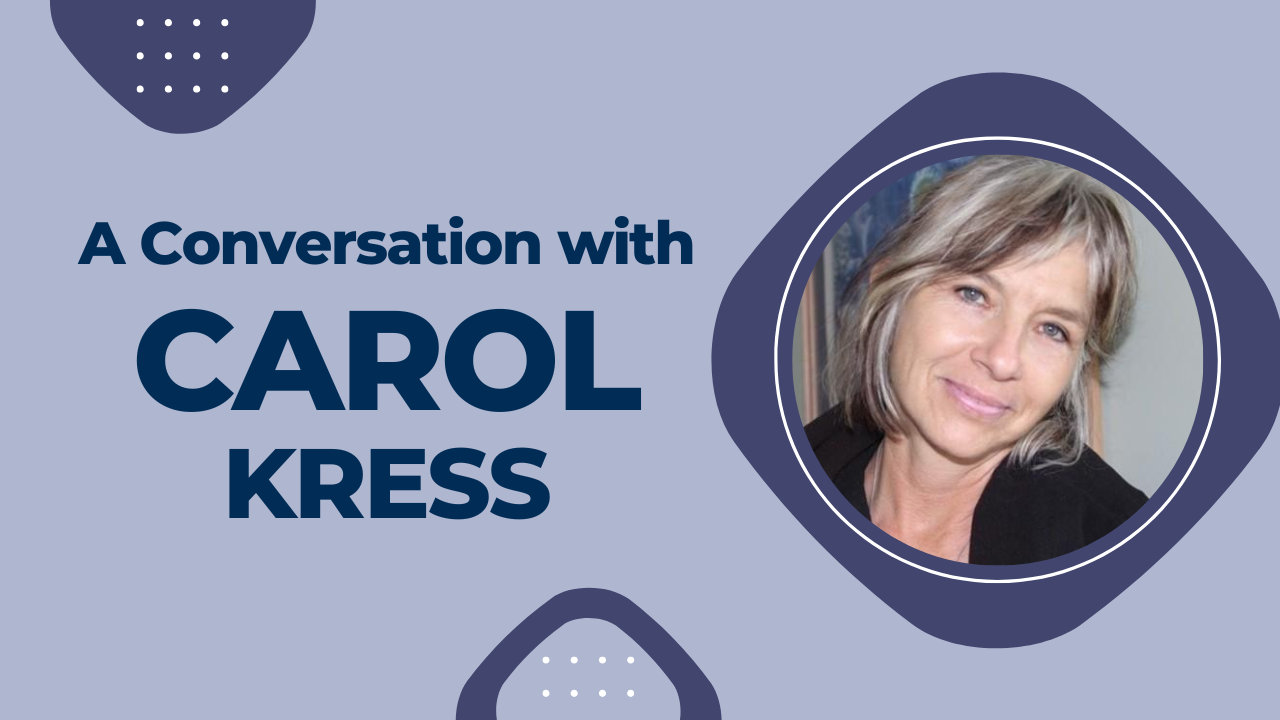
A Conversation with Carol Kress
Come as you are. Leave feeling better. Explore how movement, awareness, and imagination can open pathways to self-discovery, healing, and change.
Ira Feinstein: There is a line from the description of your upcoming workshop on June 20-21 that I’ve been mulling over for the last couple of weeks and wanted to ask you about: "The most interesting journey you will take is the few inches from habit to possibility."
The body is often seen as a closed, finite space—both familiar, because we live in it, and yet mysterious, because we spend so much time not really seeing or feeling what’s inside. How do the movements we explore in Feldenkrais lessons facilitate our exploration of Undiscovered Country?
Carol Kress: Self-discovery is what drew me in. The Feldenkrais Method — particularly Awareness Through Movement — works like a trail of bread crumbs, each lesson coaxing one a little further, a little deeper inward. That ‘unfolding’ compels me: the sense that self-knowledge isn't a destination but a continuing revelation, each layer uncovered exposing another beneath it. When I first started, it was a way of getting to know myself — not simply how I moved, or could move, but how I responded. What movements brought up in me. What my attitudes revealed about who I'd become without realizing it.
Take something as simple as moving your arm in an arc. Most of us think, "That's it, I did the movement." But the real journey is asking — what came together on the inside to produce that? When we hear an instruction from the outside, we compose it from within; mostly, we actualize it from habit. Unless we slow down. Unless we sense and pay attention. The more we know our inner landscape — and learn to put the pieces together in new ways — the more options we have for responding to whatever the world asks of us.
Ira: What has that exploration allowed you to discover in yourself?
Carol: I honestly don't know who I would be without Feldenkrais. Looking back at my childhood, I can see parts of myself that never fully developed — patterns I'd inherited and never questioned. The Feldenkrais Method began to illuminate those patterns. And what started as witnessing my responses on the floor gradually spread into my daily life, until I could see the traps I'd been in — and find a way out of them.
Ira: One of the biggest lessons for me was learning just how quickly I go from calm to extremely frustrated. When the Feldenkrais teacher asked me to move my body in a way I didn’t understand quickly, my irritation would go from 0 to 150 within seconds. I felt ridiculous. In the outside world, I could justify my frustrations, but on the floor, I couldn't because I was only being asked to move my neck a centimeter, and I’d start to feel this deep well of frustration that seemed to know no bounds. There was no way to justify my response when my intention had been to be gentle with myself!
Carol: And that's precisely where the work begins. With that awareness, you can ask: why is this response so available in me? Sometimes a strong reaction is appropriate — in the right dose, at the right moment. But often it's just an old habit firing. Seeing it clearly is the first step to having a choice.
Ira: Definitely. Over time, I was able to hold more space for frustrating events without feeling so internally frazzled. And I can now navigate the unknown with more grace.
Carol: That's it. We need to give ourselves time to find our own way. To honor our history, our limitations, whatever is present right now. It's about being truthful with yourself and trusting what emerges.
Ira: What can people expect from the lessons in your upcoming workshop?
Carol: Variety and discovery. Some lessons will be more dynamic and demanding; others will be quiet and subtle. The range is intentional.
Ira: That's great. In terms of accessibility, what options will be available to attendees?
Carol: There are always ways to modify and adapt — and we will include a demonstration of how to do lessons seated. For some movements, imagination becomes the practice itself. It’s one of the most powerful tools we have.
Ira: Sometimes we have students who report that they don’t feel they’ve successfully completed the lesson if they have to use their imagination for all, or part of it. And yet, the potency of the lesson can be accessed in your imagination. I remember one afternoon where I tweaked my back and could barely stand upright. I decided to do a lesson, but I couldn't do what was being asked of me. Every movement hurt. So I just lay on the floor and imagined myself doing the lesson. Afterward, I got up off the floor, stood up, and walked around without pain.
Carol: I had a similar experience after breaking my kneecap. My leg was braced and couldn't bend. So for one side of a lesson involving knee flexion, I could only imagine it. On the other, non-injured side, I moved physically. Afterward, the swelling in my injured knee had visibly reduced! It can feel like magic in moments like this!
Ira: We always encourage students, even if they doubt using their imagination during a Feldenkrais lesson will be effective, to give it a try. It can be hard to believe what’s possible until you experience it yourself!
Carol: That's the genius of the method — that even the smallest movement, or the quietest act of imagination, can dissolve a pattern that's been there for decades. This workshop is an invitation to map your own undiscovered country. I hope you can join us!
Find out more at: www.feldenkraisaccess.com/undiscovered-country

David Zemach-Bersin
David has maintained a Feldenkrais practice for over forty years, and has taught in Feldenkrais Training programs for 35 years. He studied directly with Moshe Feldenkrais and graduated from the first US training program in 1977.
